





Why Your Cashflow Is Suffering: Salaries Vs Total Cost of Your Employees
Jul 06, 2026
Let's say the annual salaries for the organization total $192,400.
Executive Assistant Salary: $31,200
Account Manager Salary: $61,200
CEO Salary: $100,000
Total Salaries: $192,400
Then we add in the cost of each position:
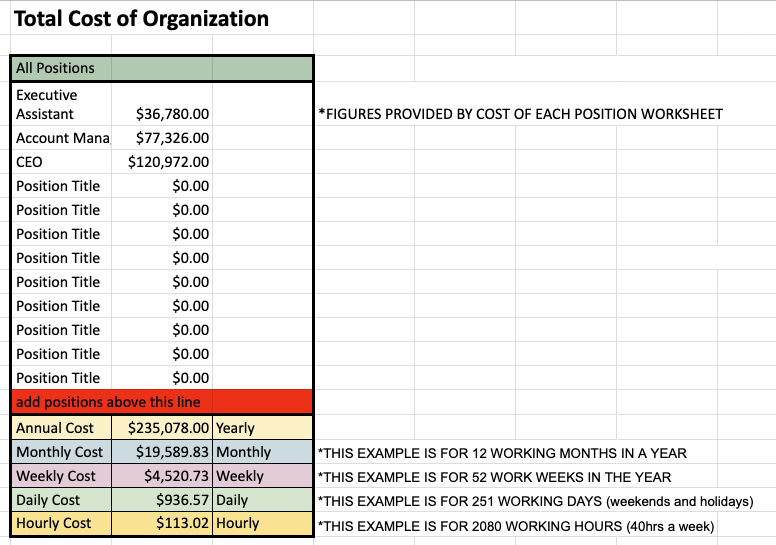
Executive Assistant Cost: $36,780
Account Manager Cost: $77,326
CEO Cost: $120,972
Total Cost of Organization: $235,078
That means the organization costs $42,678 more per year than salaries alone would suggest. And that is before a single dollar of profit is added.
This is one of the reasons so many business owners feel confused by their cash flow. They know what they pay employees. They know what payroll looks like every two weeks. What they often do not know is what it actually costs to support those employees weekly and monthly.
Breaking Down The Cost Of The Organization
Once we know the annual labor cost of the organization is $235,078, we can break it down into smaller numbers that are easier to understand.
Annual Cost: $235,078
Monthly Cost: $19,589.83
Weekly Cost: $4,520.73
Daily Cost: $936.57
Hourly Cost: $113.02
This means every hour your business is open, it costs approximately $113 just to support your team.
There’s no profit in that number. No cash reserves. No room to scale. And this is why most owners are unable to get ahead of their payroll and build a buffer. They focus on each position when bidding estimates instead of what it actually costs them to cover their entire team.
Why This Matters For Pricing
Most estimates only account for the labor directly tied to the work being performed. For example:
- A landscaping company may only include the technician's time.
- A construction company may only include the sub contractor’s time.
- A bookkeeping firm may only include the accountant's time.
- A restaurant may only include the servers and cooks time.
What often gets forgotten is the team supporting that work behind the scenes. For example:
- Someone answered the phone.
- Someone scheduled the appointment.
- Someone followed up with the customer.
- Someone managed the team.
- Someone paid the bills.
- Someone handled payroll.
- Someone created the systems that allowed the work to happen.
The customer is not paying for one employee. They are paying for an entire organization.
When business owners only price direct labor and ignore organizational labor, they often end up with strong sales and weak profits. The cost of organizational labor helps owners add in total costs for billable time versus one employee.
Friendly reminder, profit is still not added into these organizational costs. It is always important to know what employees cost an organization before adding in the profit multiplier.
Final Thoughts from Your Favorite Accountant
Before you calculate your next sales goal, calculate your total organizational labor cost.
Most business owners know what they pay their employees. Far fewer know what it costs to support their entire organization as a whole. That gap is often why cash flow may become negative and loans are needed.
The Cost of Labor Worksheet was designed to help business owners see the complete picture so they can make stronger decisions around hiring, pricing, and growth.
Because at the end of the day, positive cash flow isn't luck, it's strategy. And it's my goal to make that strategy as simple as possible for you.
Download the Cost of Labor Worksheet here.
Calculate hourly employee costs here: Here's Why Your Hourly Rates Are Off