



Here's Why Your Hourly Rates Are Off
Jul 03, 2026
If someone earns $61,200 per year, it is easy to assume that the cost of having them on the team is $61,200. But after adding payroll taxes, workers’ compensation, equipment, software, uniforms, overhead, and other position-related expenses, that same employee may actually cost the business $77,326 per year (and that doesn’t even include profit margins).
That difference catches a lot of business owners by surprise. The $61k is what we naturally focus on because that is the number we discuss during the hiring process. It is the number listed on offer letters and employment agreements. But salary is only one piece of the cost of labor puzzle. Every employee requires additional resources to perform their job successfully, and those costs add up much faster than we realize.
This is why I created the Cost of Labor Worksheet. I wanted business owners to budget for the true financial commitment attached to every position inside their company because it affects everything from capacity to pricing.
Annual Cost of an Employee
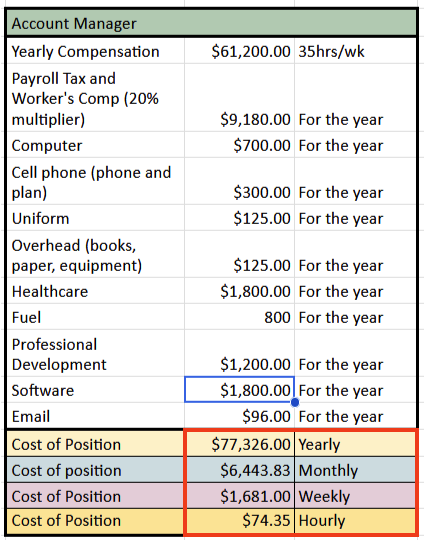
In this example, the employee's salary is $61,200 per year. Once we add all of the position-related expenses, the true annual cost becomes $77,326.
This annual number represents the total investment the company is making in that position over the course of a year. I think this number is important because it helps business owners answer a very simple question: "Can my company realistically support this employee?"
Too often, owners hire based on salary alone and are blindsided, worried, or frustrated when cash flow feels tighter than expected. Looking at the full annual investment creates a much more accurate picture of what the position actually costs.
Monthly Cost: The Budgeting Number
Once we know the annual cost of the position, we divide it by twelve months.
In this example, the employee costs the business $6,443.83 per month.
This is often the easiest number for owners to understand because most businesses operate on monthly cycles. Rent is monthly. Most subscriptions are monthly. Financial reports are reviewed monthly. Revenue goals are usually discussed monthly.
Knowing that a position costs $6,443.83 each month allows you to ask better questions:
- How many clients are needed to support that employee?
- Does recurring revenue cover that amount?
- If sales slow down for a month, will cash flow still comfortably support the position?
- How much of a cash buffer needs to be added to the SAVINGS account to support a slower month?
Those are the types of questions that help business owners hire with confidence. Even if the answers are “no”, seeds have been planted to budget and forecast to be able to hire soon.
Weekly Cost: The Capacity Number
Next, we divide the annual cost of the position by the number of working weeks in the year.
In this example, the employee costs the business $1,681 per week.
This number helps connect labor costs to productivity and capacity. Every week, the business is investing $1,681 into that role. Understanding that investment helps owners evaluate whether the position is creating the results they expected.
For a revenue-generating employee, this may mean evaluating sales activity and client acquisition. For an administrative position, it may mean looking at how much time is being returned to the revenue generators and leadership. For a technician, it may mean evaluating billable hours and project completion.
The goal is not to micromanage employees. The goal is to understand whether the investment is creating the intended impact inside the business.
Hourly Cost: The Pricing Number
This is where most business owners have their biggest realization. After breaking everything down, this employee costs the company $74.35 per hour.
Notice that I did not calculate that the employee earns $74.35 per hour. I calculated that they cost the company $74.35 per hour. AND, this number doesn’t even include a profit margin. Two important distinctions.
Many business owners build pricing based on wages instead of labor costs. They know what they are paying employees, but they forget about all the additional expenses attached to the role. As a result, they price their services too low and then wonder why cash flow continues to feel tight despite being busy and having great sales numbers that, in their mind, should be covering all costs and generating great profit margins.
When you know the true hourly cost of a position, pricing becomes much easier because you have a real number to work with and be able to add in profit margins appropriately for each position.
Final Thoughts from Your Favorite Accountant
I’ve mentioned this a couple times, but one of the most important things to understand with this Cost of Labor section, is that none of these calculations include profit.
The annual cost of $77,326 is not a revenue goal. The monthly cost of $6,443.83 is not a revenue goal. The hourly cost of $74.35 is not a revenue goal. These numbers simply represent the cost of maintaining the position. In other words, this is the break-even point for each employee hired.
The business still needs profit on top of these numbers. It still needs cash reserves. It still needs money available for growth, raises, equipment upgrades, emergencies, and future hiring decisions. That is why understanding labor costs is so important. Once the true cost of a position is known, building revenue goals that support both the employee, and the long-term health of the company can then be calculated.
Because at the end of the day, positive cash flow isn't luck, it's strategy. And it's my goal to make that strategy as simple as possible for you.
Download the Cost of Labor Worksheet here.
Calculate hiring employees here: How You Should Budget For Hiring